
-
AT Command API.
-
Libraries to compile in custom "C" Applications
Bluetooth 4.0 Single Mode Modules
 |
 |
"S" = Single Mode Low Energy (LE), BR-LE4.0-S2A and BR-LE4.0-S3A, nBlue™
"D" = Dual Mode Low Energy (LE), BR-LE4.0-D2A, BlueBridge More >>>
All pin-for-pin compatible with legacy BlueRadios Bluetooth modules.
nBlue™ nano ampere network module
(Requires no external components or firmware)
Modules easily configured to advertise as iBeacons to support immediate, near, and far proximity ranges.

Bluetooth Smart technology holds the promise of wireless connectivity everywhere, to everything.
Bluetooth Smart is an emerging open standard developed by the Bluetooth SIG that offers state-of-the-art communication technology in the sports and fitness, medical, watch, home and office and other consumer markets. Bluetooth low energy technology will offer a low-cost, low-power interface to your cellular phone, laptop, or other Bluetooth enabled product. Though Bluetooth low energy is a separate standard from Bluetooth, it can be easily integrated into existing Bluetooth chipsets and is poised for extensive roll-out in cellular phones and Bluetooth enabled devices in 2013.
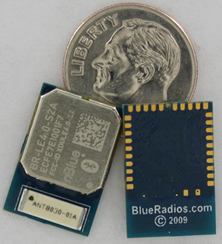 As the leader in low energy OEM RF module solutions, BlueRadios is pleased to be an active contributor to the emerging Bluetooth 4.0 low energy industry. The nBlue BR-LE4.0-S2A which is the first operational single-mode, system-on-chip module to support Bluetooth low energy. Also first to market is BlueBridge BR-LE4.0-D2A a Dual mode version with the exact same packaging and pin outs.
 BR-LE4.0-S2A (CC2540) Summary Spec. (459KB)
BR-LE4.0-S3A (CC2541) Summary Spec. (459KB)
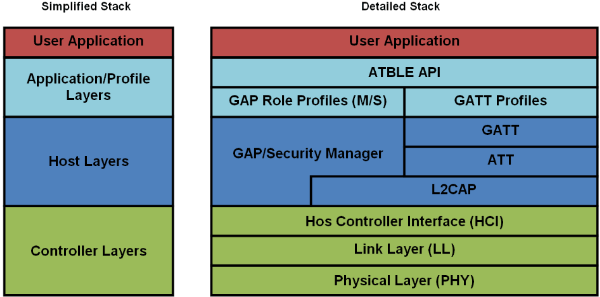
nBlue BR-LE4.0-S2A is a standalone Class1 module solution and requires no firmware or external components! Custom client applications can be written directly onto the nBlue, which supports both analog and digital peripherals, eliminating the need for a second costly microprocessor (see stack below). Alternately, the BR-LE4.0-S2A can be integrated into an existing design as a HCI network processor device, with a host processor running the core application and the BR-LE4.0-S2A providing Bluetooth low energy communications.
Bluetooth Low Energy Fact Sheet (34KB)
Chip-on-Board vs. Turnkey Module Comparison (82KB)
Module vs. Discrete Design Total Cost of Ownership (39KB)
PCB Related Documents:
S2A/S3A/D2A Overall Dimensions (Antenna) (146KB)
S2A/S3A/D2A SMT Land Dimensions (154KB)
Solder-Waveflow (77KB)
Reliability Test Report (499KB)
S2/S3/D2 Module Footprint Drawing (140KB)
 PCAD Radio Foot Print(s) Library (Zip file) (4KB)
Eagle Foot Print(s) Library (Zip file) (3KB)
RF Related Documents:
S2A/S3A/D2A Ceramic Chip Antenna Data Sheet (799KB)
RF Exposure (12KB)
Regulatory Documents:
FCC Grant Approval (66KB)
IC Grant (36KB)
FCC IC Test Report (1609KB)
CE Grant Approval (845KB)
Declaration of Conformity (352KB)
RoHS & Reach Cert. (467KB)
Bluetooth
QDID: B016552 Controller Subsystem
QDID: B017183 Host Subsystem
QDID: B019095 BLE Profiles
nBlue™ Single Mode Low Energy Smart Modules (Protocol Stack)
The Bluetooth low energy protocol stack is built similarly to BR/EDR stack, with a controller layer at the bottom, followed by a host layer, and finally the profile and application layers. The nBlue modules contain a full stack all the way up to the application layer as seen below. The ATBLE API contains all the necessary commands to enable the user to quickly and easily develop a fully-featured BLE application. The User Application can use the ATBLE API through the UART, using an external micro controller, or by writing a custom application to run on the GAP and GATT layers. Standard Bluetooth Low Energy profiles supported: Embedded Bluetooth Stack Protocols and Profiles (Master/Slave) include: GAP, GATT, SMP, ATT, L2CAP, BAS, BLP, BLS, DIS, FMP, ANP, HIDS, HOGP, HID, HTP, HTS, HRP, HRS, IOP, IAS, LLS, PASP, PXP, SCPP, SCPS, TIP, TPS, and BRSP.
Generic BLE profiles supported with AT Commands the rest with "C" library.
Firmware Options
Why Bluetooth Low Energy from BlueRadios?
-
BlueRadios provides traditional, single-mode, and dual-mode Bluetooth modules in the same footprint.
-
BlueRadios shipped the world’s first (controller, host, and application on one device) single-mode Bluetooth low energy turnkey module using a TI 8051 core CC2540 baseband.
-
BlueRadios shipped the world’s first dual mode turnkey module solution.
-
BlueRadios provides a total module solution: RF ICs, protocol stacks, profile software, application examples, development kits, integrated antenna, plus end certifications.
-
Taking advantage of the BR-LE4.0-D2A Bluetooth dual-mode infrastructure, single-mode Bluetooth devices like BlueRadios BR-LE4.0-S2A offer a low-cost, low-power solution that easily integrates into existing or new products.
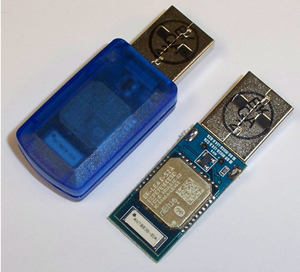
USB Evaluation Dongle (pictured right)
BR-MUSB-LE4.0-S2A (361KB) nBlue™
-
Contains BR-LE4.0-S2A module
-
Status LEDs
-
Translucent blue ABS plastic enclosure
-
No software drivers required
-
Serial FTDI or USB 2.0 support
-
30(L) X 18(W) X 10(H)mm (1.2" X 0.71" X 0.40")
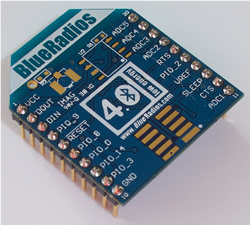
BR-XB-LE4.0-S2A XBee® Foot Print (pictured right) (196KB) nBlue™
Tools:
$199 BlueSniff™ BR-USB-LE4.0-S2ABS
Bluetooth 4.0 Single Mode Protocol Packet Sniffer (328KB)
-
Includes USB Hardware Dongle (similar to one pictured above with plastic enclosure)
-
Comes with download link for Windows based PC software
APPLICATIONS
nBlue module communicating once a second consumes 30uA on average. To put this in perspective, 30uA corresponds to 330 days of battery life using a CR2032 coin cell.
BLE is not recommended for data streaming applications over the standard defined profiles like GAP & GATT. Bluetooth Low Energy does not support BT SIG Serial Port Profile (SPP). BLE is not backwards compatible with legacy Bluetooth devices.
|
|
Bluetooth low energy Single mode is not compatible with legacy Bluetooth only Dual mode devices are. Single mode is ideal for end devices and dual mode is for gateway type devices like PC, laptop, and cell phones.